Research perspective · 01
Closing the loop in
precision oncology
A practical route from perturbation data to treatment hypotheses, informative experiments, and patient evidence.
A drug reduces the tumour-cell population, but some cells survive. Should the next experiment increase the dose, add a second drug, or change the treatment schedule? A sensitivity score alone leaves much of that decision unresolved.
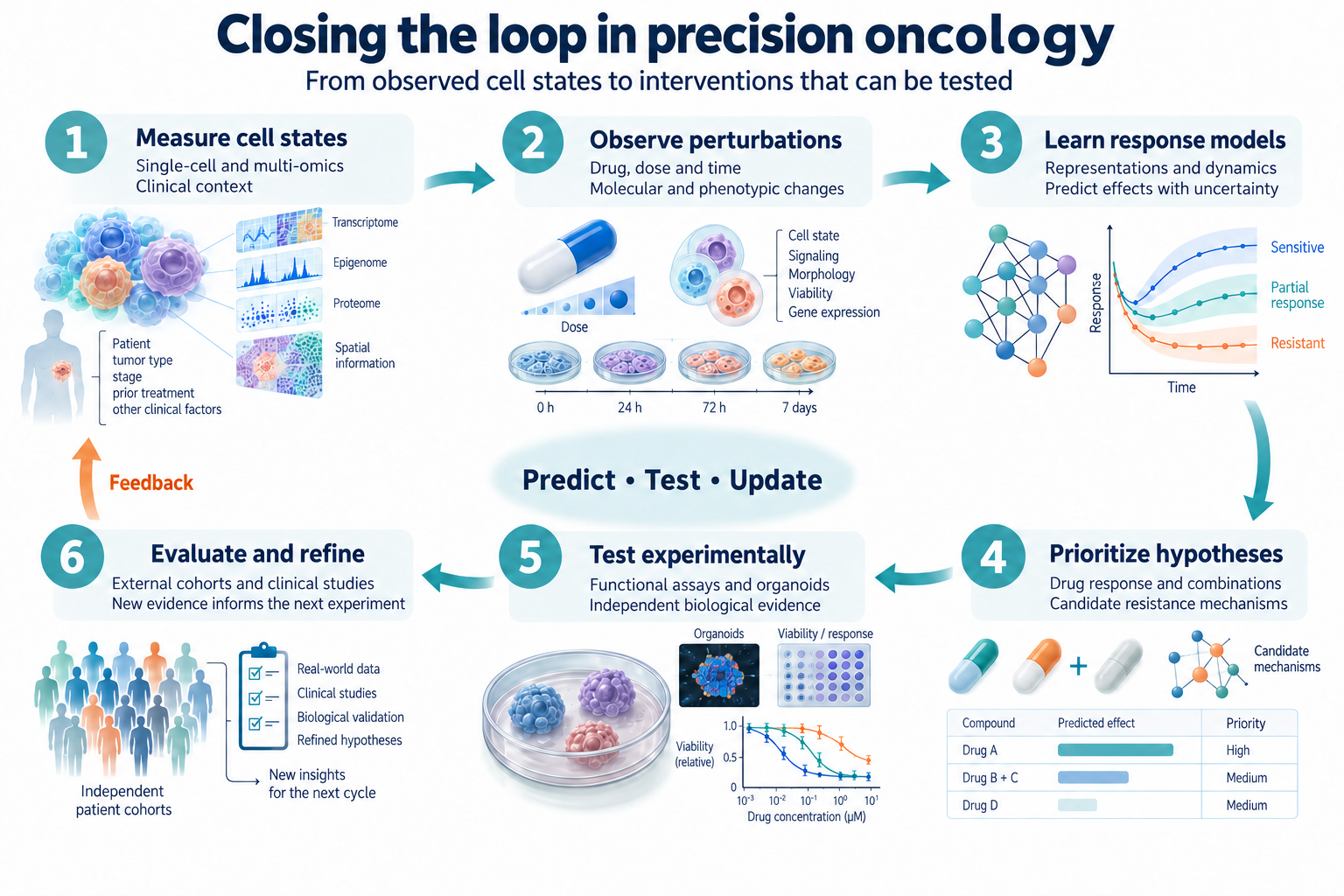
This is where virtual cells become interesting for precision oncology. Models could help connect a starting molecular state to a treatment response, identify a possible reason for survival, and choose an experiment that separates competing explanations. The cycle becomes useful when each result changes what we measure or test next.
ProteinTalks offers a concrete example of part of this route: learning from drug-induced protein changes over time, then using those representations for drug-response tasks.1 The wider question is how to build a study around such a model so that prediction, mechanism, and experimental evidence inform one another.
1. Start with the treatment decision
Consider two cell populations with similar viability after 72 hours. One barely responds throughout the experiment. The other initially responds strongly, then recovers. Their endpoints are similar, but the follow-up questions differ: was the target engaged in the first population, and what allowed the second to recover?
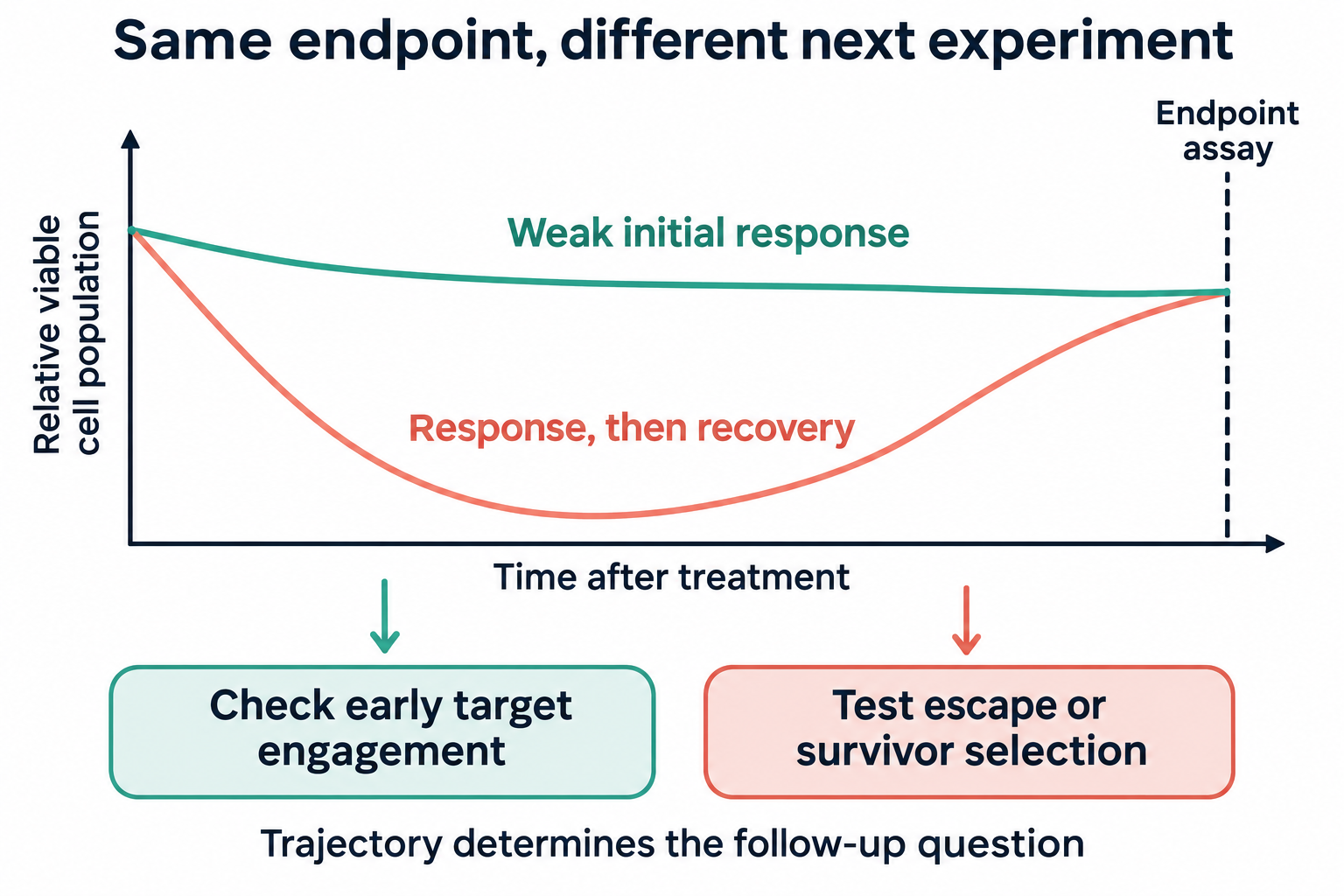
That distinction should shape data collection before model selection. Baseline omics can describe a starting state. Matched treatment conditions, dose, and sampling times reveal response patterns. Measurements of abundance, death, and proliferation help interpret what a changing molecular profile means. Qian and colleagues place perturbation dynamics alongside biological knowledge and cellular architecture in their framework for AI virtual cells.2
| Question | Useful evidence | What it helps distinguish |
|---|---|---|
| Did the drug affect its intended pathway? | Early molecular readouts under matched control and treatment conditions | Failure to engage the pathway versus a later escape response |
| Which cells remain after treatment? | Single-cell profiles together with cell abundance or viability | A changed state versus a changed population composition |
| Does the order of two treatments matter? | Sequential exposures with measurements between them | A schedule-dependent effect versus an effect seen only under simultaneous treatment |
| Does the signal transfer to another biological setting? | Held-out donors, models, or patient-derived material | A reproducible response versus dependence on the discovery system |
For destructive assays such as single-cell RNA sequencing, successive samples usually contain different cells. A trajectory inferred from them describes population changes; lineage tracing or live imaging can help determine whether individual cells changed state or particular cells survived. This affects the interpretation of the model’s target, even if prediction accuracy is high.
2. Give the model an output that leads to an experiment
A useful response model connects the pretreatment state, intervention, and observation time to a defined readout. Depending on the study, that readout might be protein abundance, an expression distribution, or viability. Keeping the molecular and phenotypic outputs separate makes it possible to ask whether a predicted molecular change actually accompanies the treatment effect.
ProteinTalks makes this connection through temporal proteomics. Its workflow includes measurements before treatment and at 6, 24, and 48 hours, learning dynamic latent representations and predicting perturbed protein profiles. These representations support tasks including efficacy and synergy prediction, resistance-associated protein analysis, and candidate prioritization for patient-derived organoids.1 The study’s workflow figure is useful for seeing how the molecular model and downstream response tasks fit together.
Xing and Song’s virtual-cell framework adds a useful longer-term goal: retain the cellular state after an intervention so that a second intervention can act on that changed state.5 This would make treatment order an explicit experimental question.
The design lesson is to preserve the link between the predicted molecular response and the experiment it could motivate. A higher sensitivity score can rank a compound. A predicted response followed by recovery can also suggest when to sample and which candidate dependency to investigate.
3. Turn a response pattern into a testable explanation
Suppose a model predicts that drug A suppresses a pathway initially, followed by a rebound associated with pathway B. Adding an inhibitor of B is one hypothesis. Another is that treatment selected a pre-existing population that already depended on B. These explanations could produce a similar average profile and require different follow-up experiments.
An experiment should therefore test both the proposed intervention and the explanation behind it. Compare A alone, B alone, and the combination across a dose range. Measure the candidate pathway before the phenotype diverges. Use an independent perturbation of the candidate dependency where feasible. Single-cell or lineage measurements can help assess selection versus adaptation. A combination effect becomes easier to interpret when the timing, molecular readout, and phenotype agree.
This is also a useful way to read model interpretability results. An attention weight, an important feature, and a predicted pathway change can each nominate something to test. The dependency claim comes from the follow-up evidence.
4. Make the next experiment informative
A closed loop needs a rule for deciding what to do after a prediction succeeds or fails. Repeating the easiest conditions may improve an average metric while leaving the treatment question unresolved. The more valuable experiment may be the one on which two plausible explanations disagree. This connects the virtual-cell vision of model-guided experimentation to a practical choice of samples and assays.2, 3
| Observed result | Question it raises | Useful next experiment |
|---|---|---|
| Recovery occurs earlier than predicted | Was an early response or transition missed? | Sample more densely around the onset of recovery |
| The average response is predicted well, but a small population survives | Does the model miss a rare resistant state? | Profile survivors and measure their abundance; examine lineage where possible |
| The combination works, but the proposed pathway readout does not change | Is the explanation wrong, or is the readout poorly chosen? | Test target engagement and an independent perturbation of the proposed dependency |
| A cell-line result fails in an organoid | Which difference in exposure, composition, or context matters? | Compare matched conditions and molecular responses before expanding the screen |
These are experimental design examples. In a real study, the feedback record should retain the condition, model prediction, uncertainty, measured result, and resulting decision. That record makes it possible to evaluate whether the model helped choose better experiments, rather than only whether another training round improved its fit.
5. Build the bridge to patients one question at a time
Functional assays test a proposed dependency. Organoids test response in patient-derived material. Cohorts ask whether a signal remains informative alongside clinical variation. Each adds a different kind of evidence to the loop.
For patient transfer, treatment exposure, tolerability, sampling time, and tumour heterogeneity become part of the problem. An organoid response can motivate a candidate treatment hypothesis; patient benefit requires clinical evaluation. A patient-specific digital twin adds another requirement: updating its estimate as new observations arrive during treatment.4
The most useful starting point is a bounded question: can a model identify an early escape response, nominate a way to interrupt it, and help choose the experiment that tests that explanation? Solving that question would establish a small working loop. Its failures would then tell us which biological contexts, measurements, and model capabilities the next loop needs.
References
- Sun, R. et al. An operational perturbation proteomics-based virtual cell model. Nature (2026).
- Qian, L., Dong, Z. & Guo, T. Grow AI virtual cells: three data pillars and closed-loop learning. Cell Research 35, 319–321 (2025).
- Bunne, C. et al. How to build the virtual cell with artificial intelligence: Priorities and opportunities. Cell 187, 7045–7063 (2024).
-
Asghar, U. S. & Chung, C. Application of digital twins for personalized oncology. Nature Reviews Cancer 25, 823–825 (2025).
- Xing, E. P. & Song, L. A world model of the virtual cell. Cell 189, 5831–5844 (2026).