Research perspective · 03
World models in biomedicine
A practical map of patient simulators, imaging dynamics, and cellular response models: how they work, what their data support, and how predictions can guide the next experiment.
Two tumours can have similar expression profiles today and respond differently to the same drug. Prior treatment, resistant subpopulations, and the surrounding tissue may change what happens next. A model that recognizes the current molecular state therefore solves only part of the treatment problem.
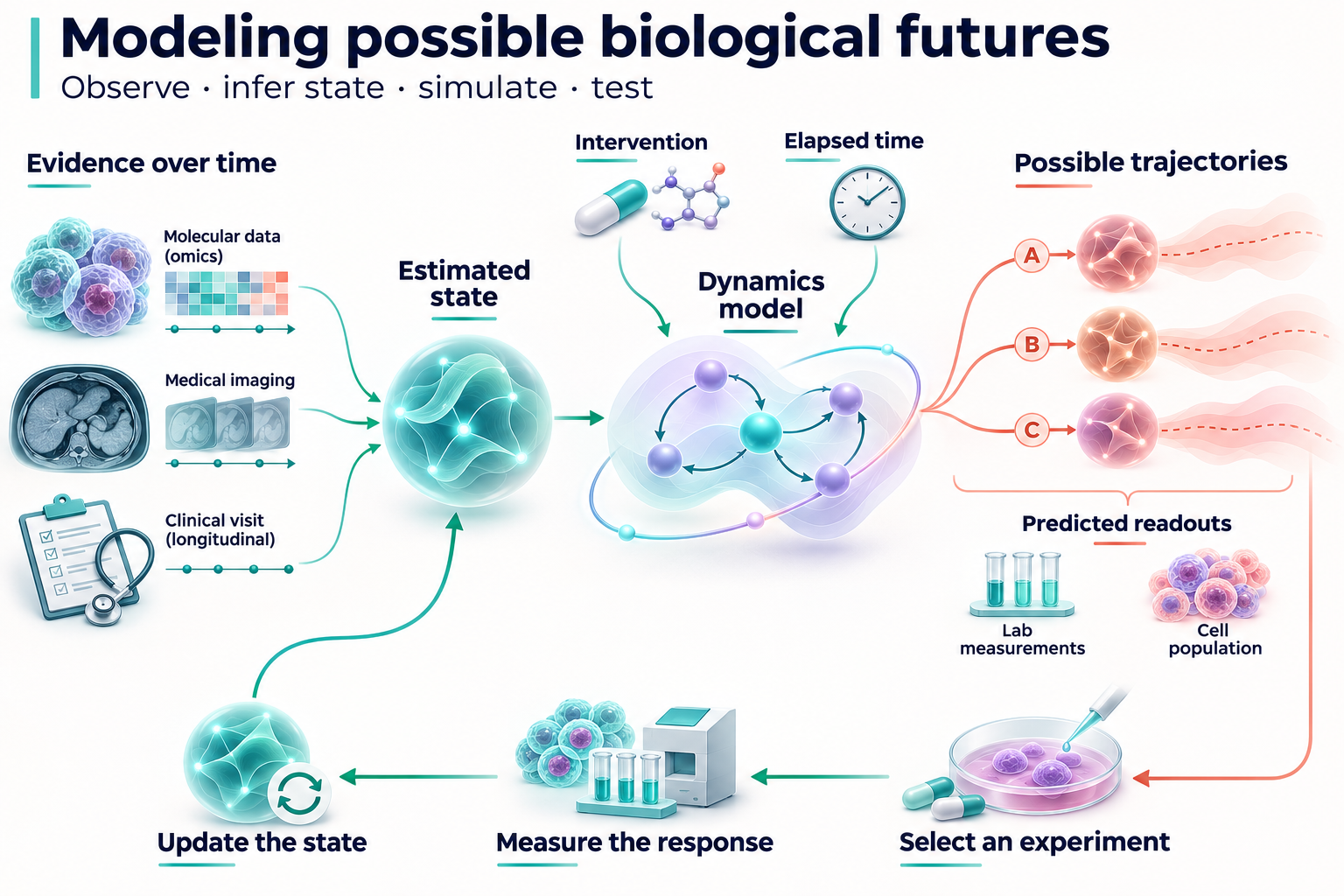
World models bring the next part into focus: how does a biological system change, and how would that change depend on an intervention? The useful output might be a future cell-state distribution, a tumour image, or a sequence of clinical measurements. Once those predictions can be continued, the model becomes a simulator in which different intervention sequences can be explored.
The perspective World models for biomedicine provides a useful framework for this idea.1 Recent medical papers also show why the term needs unpacking. Some generate future images, some evolve patient representations, and others connect a simulator to an agent. These designs solve different parts of the problem.
1. The model needs a state that can change
A biomedical world model has three central components: a representation of the current system, an action, and a rule for predicting the next state. In compact form:
Current state + action + elapsed time → distribution of possible next states.
The state is inferred from observations. A blood test is a measurement of part of a patient’s condition; it is not the whole condition. Likewise, a single-cell profile measures one aspect of a cell, while exposure history and its environment may remain unobserved. The model may need a history of measurements to construct a useful state.
An action must also be more specific than “treated.” Drug identity, dose, duration, and order can matter. Predicting treatment A followed by B requires retaining the changes caused by A when simulating B. If every prediction starts again from an untreated baseline, the model cannot answer that sequence question.
The transition rule can be mechanistic, learned, or a combination of both. A differential-equation model of drug exposure and response can serve this role, as can a neural dynamics model. Transformer, diffusion, and flow-matching architectures are implementation choices; none establishes the capability by its name alone.1
Where foundation models, digital twins, and agents fit
These terms describe different roles, and one system can combine them.
| Component | Main question | Role in a biomedical study |
|---|---|---|
| Foundation model | What useful representation can be learned across many samples and tasks? | Can provide an encoder for cells, images, or clinical records; transition learning is an additional task |
| World model | How might the state evolve under an action? | Predicts transitions that can support simulated continuations |
| Digital twin | Which particular patient or biological system does this model represent? | Personalizes a model using observations from that individual; a dynamic twin may use a world model |
| Agent / policy | Which action should be considered next? | Proposes or selects actions using a goal, constraints, and possibly a world model |
A large single-cell encoder could supply the state representation for a virtual cell. A transition model could then predict its response to a perturbation. Personalizing a simulator to a patient would move toward a digital twin; adding an agent could help search candidate interventions. Each addition requires its own data and evaluation. An agent’s repeated conversation with a simulator is also different from updating that simulator with a new experiment.
2. Medical world models are taking several routes
The clearest way to read this literature is to ask what each model treats as its state, what changes it simulates, and how those predictions are evaluated. The table includes two adjacent approaches, Delphi-2M and CellFlow, because they help locate the boundary between trajectory generation, perturbation prediction, and intervention simulation.
| Model / publication | State and inputs | Predicted change | Evidence to read it against |
|---|---|---|---|
| Delphi-2M Nature, 2025 [2] | Demographics, health history, and diagnosis events | Next disease event and waiting time, recursively sampled | Disease-trajectory prediction with external population evaluation; not a validated treatment-effect simulator |
| EHRWorld arXiv, 2026 [3] | Patient history from notes and structured clinical events | Clinical observations and evolving records under inquiry or intervention inputs | Learned clinical trajectories from retrospective EHRs |
| MeWM ICCV, 2025 [4] | Liver tumour CT, masks, and treatment-protocol conditions | Post-treatment tumour images using a diffusion model | Image-generation and retrospective treatment-planning evaluations |
| CLARITY arXiv v1, 2025 [5] | MRI-derived state, clinical context, therapy, and follow-up interval | Post-treatment latent representation and survival-related predictions | Latent prediction and model-based therapy-ranking experiments |
| PulmoWorld arXiv v1, 2026 [6] | Irregular clinical, imaging, and molecular observations with care history | Recursive clinical values and modality representations | Real-cohort forecasting; planning evaluated separately in known-mechanism synthetic environments |
| SepsisAgent arXiv, 2026 [7] | Clinical state and treatment history; fluid and vasopressor actions | Numerical patient dynamics used to train and evaluate an LLM policy | Retrospective off-policy evaluation and safety proxies |
| SurgWM arXiv, 2025 [8] | Surgical video and inferred latent actions | Future video frames conditioned on action codes | Video generation and latent control; action codes are not established clinical commands |
| CellFlow bioRxiv / software, 2025 [9] | Cell populations and perturbation conditions | Single-cell phenotype distributions using flow matching | A related response-modeling building block; biological rollouts require separate evidence |
Clinical histories supply trajectories, but treatment comparisons are harder
Delphi-2M generates disease histories by predicting both the next event and when it occurs. Its UK Biobank development and Danish population evaluation make it an informative example of learning long-range health trajectories.2 EHRWorld moves toward an interactive patient interface, generating evolving clinical observations from notes and structured records.3
The extra challenge is interpreting an action. In routine records, the sickest patients may receive the most intensive care. A model can learn that association very accurately while still predicting the wrong effect of changing treatment. Learning how records unfold and identifying what an intervention would cause are separate achievements.
Imaging models choose between visible futures and compact states
MeWM uses a generative image route: a proposed treatment conditions a simulated post-treatment tumour CT, which can be assessed by downstream models. CLARITY instead predicts an imaging representation, incorporating clinical context and elapsed time, and connects that representation to survival-related scoring.4, 5
This is a useful design choice beyond these two papers. Images make a predicted change inspectable. Latent states make repeated simulation cheaper and can focus learning on task-relevant information. The test is whether the representation preserves what later decisions need. An embedding optimized only for tumour size, for example, could discard information needed to model a different response.
PulmoWorld makes the observation process part of the problem
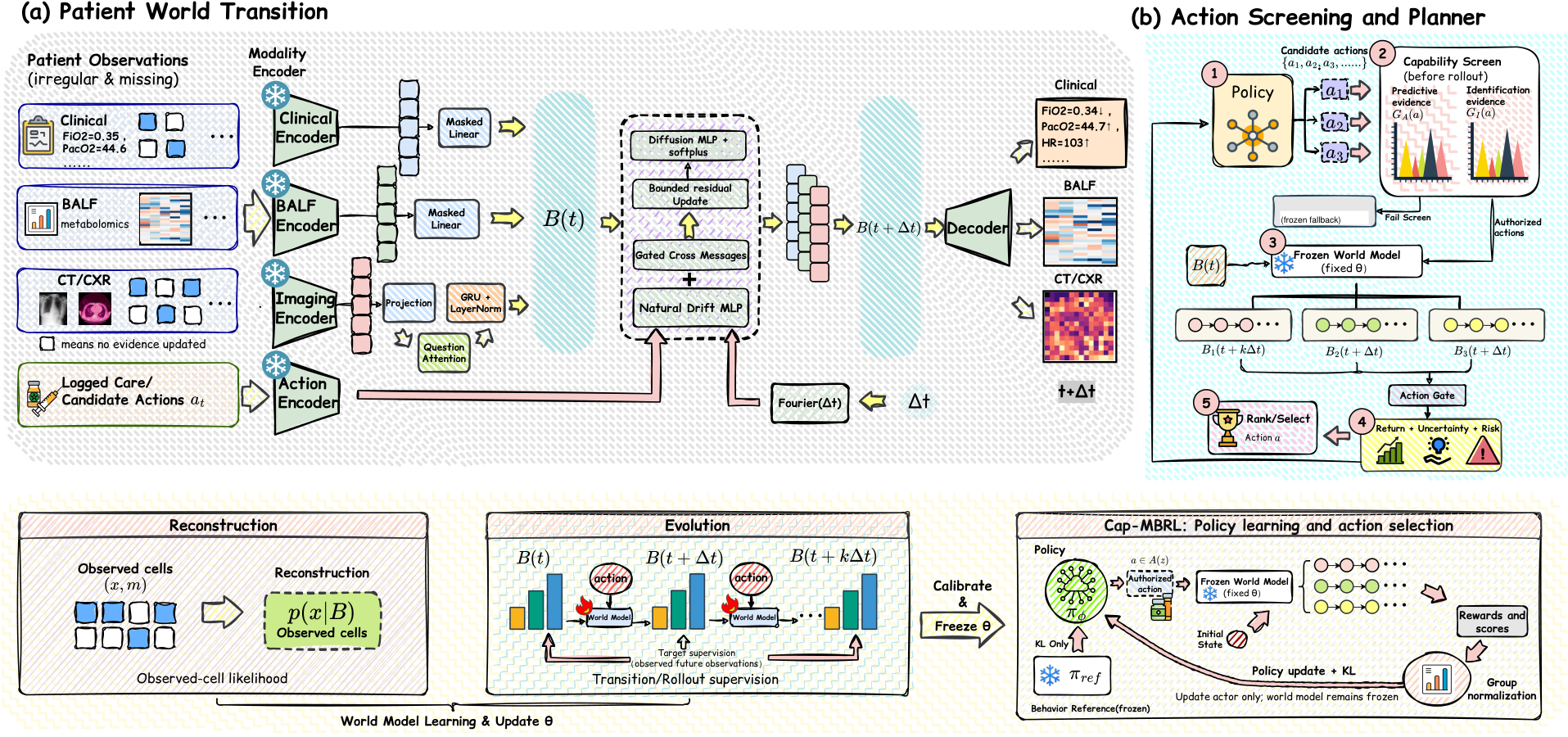
A CT scan from yesterday and a laboratory measurement from this morning are not simultaneous observations. PulmoWorld separates advancing the patient state through time from correcting it when a measurement arrives. Missing measurements supply no correction. It then recursively predicts clinical values and modality representations.6
The distinction between its experiments matters: forecasting is evaluated on real cohorts, with models trained separately for MASS and MIMIC-IV-CXR; action selection is tested in five synthetic environments with known mechanisms. That supports examining asynchronous state estimation and planning behavior without treating simulated policy gains as patient benefit.
In the method figure, follow the left-hand path from irregular observations to the shared state and future readouts. The separate right-hand branch screens and ranks candidate actions using the learned simulator. Keeping those paths distinct helps separate the question of forecasting a state from choosing an intervention.
SepsisAgent illustrates another division of work: a numerical world model simulates patient dynamics, while an LLM policy learns to use it. Its retrospective off-policy estimates are evidence about that experimental setup, rather than a clinical trial of the proposed care policy.7
3. A virtual cell needs more than a good cell embedding
A concrete architecture for the cellular state
Xing and Song’s A world model of the virtual cell proposes three coupled components: an encoder combines observations into a cellular state; an action-conditioned transition model evolves that state; a decoder generates molecular and phenotypic readouts from it.10 The outputs should remain consistent with the same underlying state.
This gives a practical test for a proposed simulator: apply treatment A, retain the resulting state, then simulate B from there. Re-encoding an untreated baseline for each drug would lose that treatment history. The paper provides an architectural roadmap; stable sequential simulation and consistent readouts still need experimental evaluation.
Match the transition to the available measurements
Single-cell models provide an appealing starting point because perturbations can be experimentally assigned. But the data structure determines the question we can ask.
An untreated cell atlas can teach a model which states are common. A perturbation screen adds information about how populations respond to an intervention. Repeated measurements add temporal structure. Sequential perturbations can reveal whether the first exposure changes the response to the second. More cells at one endpoint improve coverage of that endpoint; they do not supply the missing time course.1
CellFlow is a useful related example: it models phenotype distributions under complex perturbations, including drug and genetic interventions.9 Such response models can contribute a transition component. However, a flow model’s internal integration variable is not automatically biological time. Interpolating between distributions is different from establishing what happens after six hours, two days, or a second treatment.
There is also a measurement issue. Destructive RNA assays usually compare different sampled cells. A population shift may reflect altered expression, selective cell death, proliferation, or a change in cell composition. A useful virtual-cell study should specify which of these its output represents. Live imaging, lineage information, and measurements of abundance or viability can help distinguish them.1
| Available data | A useful first task | What the next step needs |
|---|---|---|
| Baseline omics + patient outcomes | Representation learning and prognosis at a defined prediction time | Follow-up states and dated interventions to model changes |
| Control + treated cells at one endpoint | Predict the treated population distribution or a response summary | Dose, time, and sequential exposures for richer intervention questions |
| Perturbations sampled at several times | Model time-dependent population responses | Evidence linking states across time; composition and viability measurements where relevant |
| Repeated patient measurements + treatment history | Predict transitions across irregular follow-up intervals | Appropriate treatment-effect assumptions or controlled evidence before causal policy comparisons |
| Assigned intervention sequences + repeated observations | Test action order, continued simulation, and adaptive experimental choices | Independent prospective tests against a fixed decision baseline |
4. Continuous simulation changes how the model should be tested
A model can predict tomorrow well when it receives today’s true measurements at every step. It may perform very differently when tomorrow’s prediction becomes the input for the following day. Small errors can compound, and predicted states can drift into regions that the model never encountered during training.1
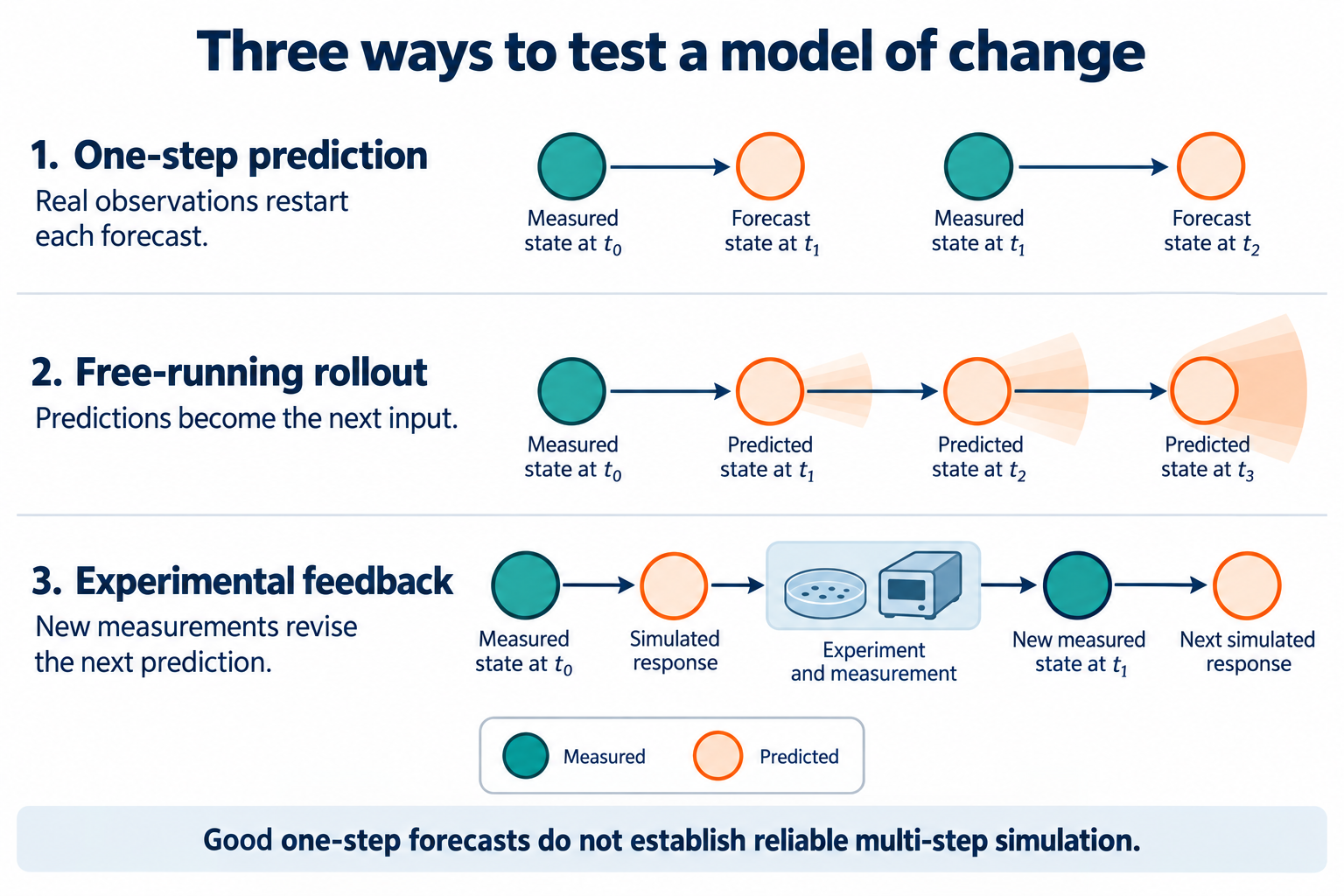
Three comparisons are particularly informative. First, remove the action input: if predictions barely change, the model may mainly recognize cell type or disease severity. Second, test genuinely new combinations of initial state and intervention, keeping donors or patients separate. Third, compare a direct long-horizon forecast with a free-running rollout over the same interval. This exposes whether good short-term predictions remain useful when composed.1
For planning, another test becomes necessary: do the selected experiments improve on a simple selection rule under the same budget? A planner searches for the largest predicted advantage and can therefore exploit the simulator’s errors. Measuring the selected intervention supplies evidence that simulated scores alone cannot provide.
5. A productive direction: small, testable biological worlds
The most useful starting point may be a deliberately narrow system: one cell context, a defined set of perturbations, and a response that can be measured repeatedly. Learn the transition, test it on held-out conditions, and only then ask whether a second simulated intervention remains accurate. This makes the missing information visible before expanding to a larger model.
The state representation is an important research target in its own right. A representation that separates cell types may still merge cells with different response histories. One practical test is to add exposure history to the model: if it improves future prediction, the original state was missing information relevant to the transition.
The longer-term opportunity is to use these models to choose informative experiments. When plausible models agree on the current data but predict different responses to a particular intervention, that intervention can become a useful test. Its measurement updates both the state estimate and our understanding of the dynamics. This gives a concrete purpose to the loop: each experiment helps decide which biological prediction to trust and which question to ask next.
References and resources
- Noori A et al. World models for biomedicine. Cell 189, 5845–5869 (2026). Perspective.
- Shmatko A et al. Learning the natural history of human disease with generative transformers. Nature 647, 248–256 (2025). Delphi code.
- EHRWorld: A Patient-Centric Medical World Model for Long-Horizon Clinical Trajectories. arXiv preprint (2026).
- Yang Y et al. Medical World Model. ICCV, 8319–8329 (2025).
- Ding T et al. CLARITY: Medical World Model for Guiding Treatment Decisions by Modeling Context-Aware Disease Trajectories in Latent Space. arXiv preprint, v1 (2025).
- PulmoWorld: An Asynchronous Multimodal Medical World Model for Longitudinal Pneumonia Dynamics. arXiv preprint, v1 (2026).
- Wu M et al. Agentifying Patient Dynamics within LLMs through Interacting with Clinical World Model. arXiv preprint (2026).
- Koju S et al. Surgical Vision World Model. arXiv preprint (2025). SurgWM code.
-
Klein D et al. CellFlow enables generative single-cell phenotype modeling with flow matching. bioRxiv preprint (2025). Code and documentation.
- Xing, E. P. & Song, L. A world model of the virtual cell. Cell 189, 5831–5844 (2026).