Research Highlight · Neuro-Oncology Advances
Explainable ML/AI model for postoperative survival in RCC brain metastasis
Patients undergoing resection of RCC brain metastases can have very different survival trajectories. This study asks how clinical and radiologic information can support postoperative prognosis, with predictions that can be examined alongside the patient's features.
- Cohort
- 253 surgically treated patients
- Endpoint
- Overall survival after resection
- Evaluation
- Internal train/test split
The postoperative prediction task
The retrospective cohort comes from a single tertiary referral centre. Several survival models were compared, and the selected approach combined XGBoostCox and partial least squares Cox regression (plsRcox). Its prediction target is survival after surgery among patients who underwent resection.
Held-out performance
The test C-index was 0.59. Test AUCs at 1, 2, and 5 years were 0.61, 0.64, and 0.69. Risk groups defined using the training cohort separated survival in the test cohort, with a high-versus-low-risk hazard ratio of 2.06.
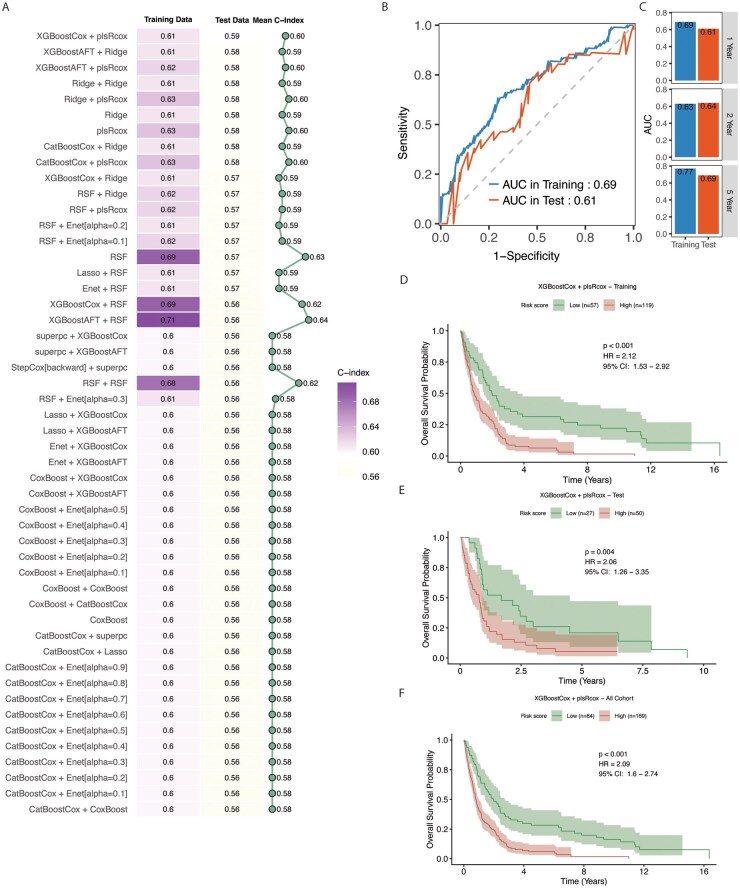
The held-out discrimination is modest. Risk-group separation and patient-level probability accuracy should be assessed separately: a significant difference between two survival curves does not by itself establish that every individual's predicted probability is well calibrated.
Individual predictions
SHAP analysis highlights contributions from extracranial disease status, brain-metastasis burden, preoperative symptoms, and age. The examples below connect those feature contributions to an individual survival estimate and the calculator interface.
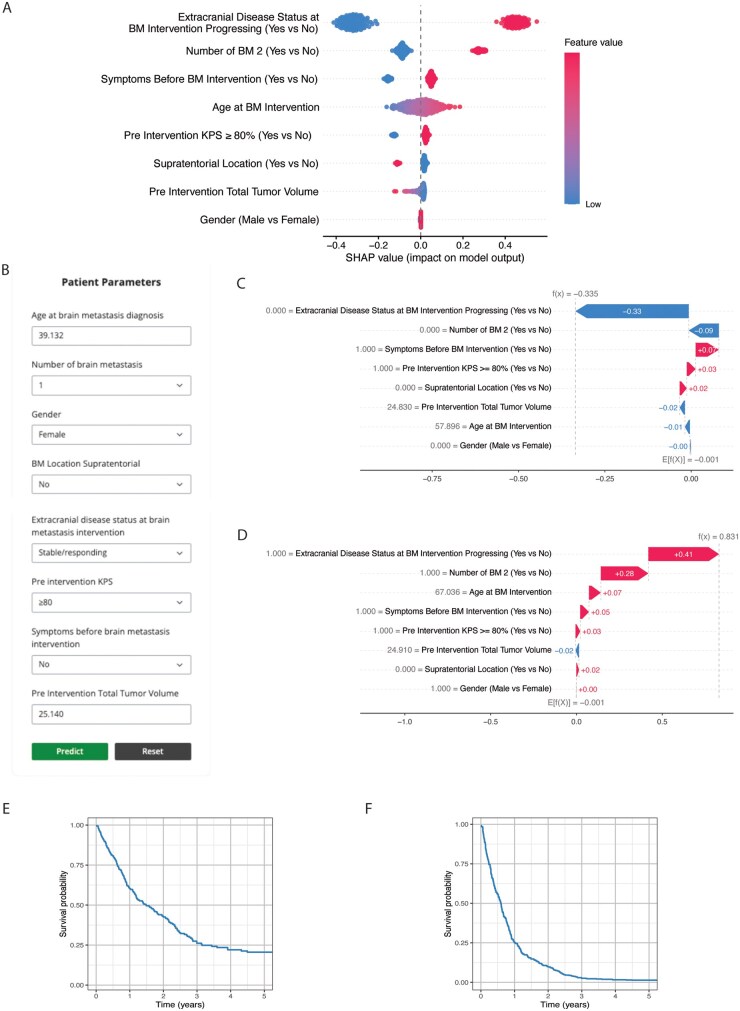
For an individual case, a useful review is to check whether the inputs match the clinical record, inspect which variables drive the estimate, and compare that pattern with the cohort used to develop the model. This makes an unexpected prediction easier to investigate.
Use and next validation
The online calculator makes the model available for research and further evaluation. Testing in another centre would establish how well the estimates transfer across surgical selection, follow-up practice, and patient mix. Estimating the benefit of choosing surgery would require a different study design with an appropriate treatment comparison.