Research Highlight · AACR Drug Discovery and Development 2026
In-silico Phase III trial of avelumab plus axitinib versus sunitinib in advanced renal cell carcinoma
A randomized trial offers a useful test for an in-silico treatment comparison: can the computational analysis recover the contrast already observed in the trial? This AACR D3 abstract examines that question using RNA-seq data from JAVELIN Renal 101.
- Treatment comparison
- Avelumab + axitinib vs sunitinib
- Approach
- Cross-arm model transfer
- Evidence stage
- Conference abstract
The cross-arm experiment
Survival models are trained within the two treatment arms, then each is applied to patients in the opposite arm. This produces model-based predictions under the alternative regimen. Aggregating those predictions creates a treatment contrast that can be compared with the observed trial result.
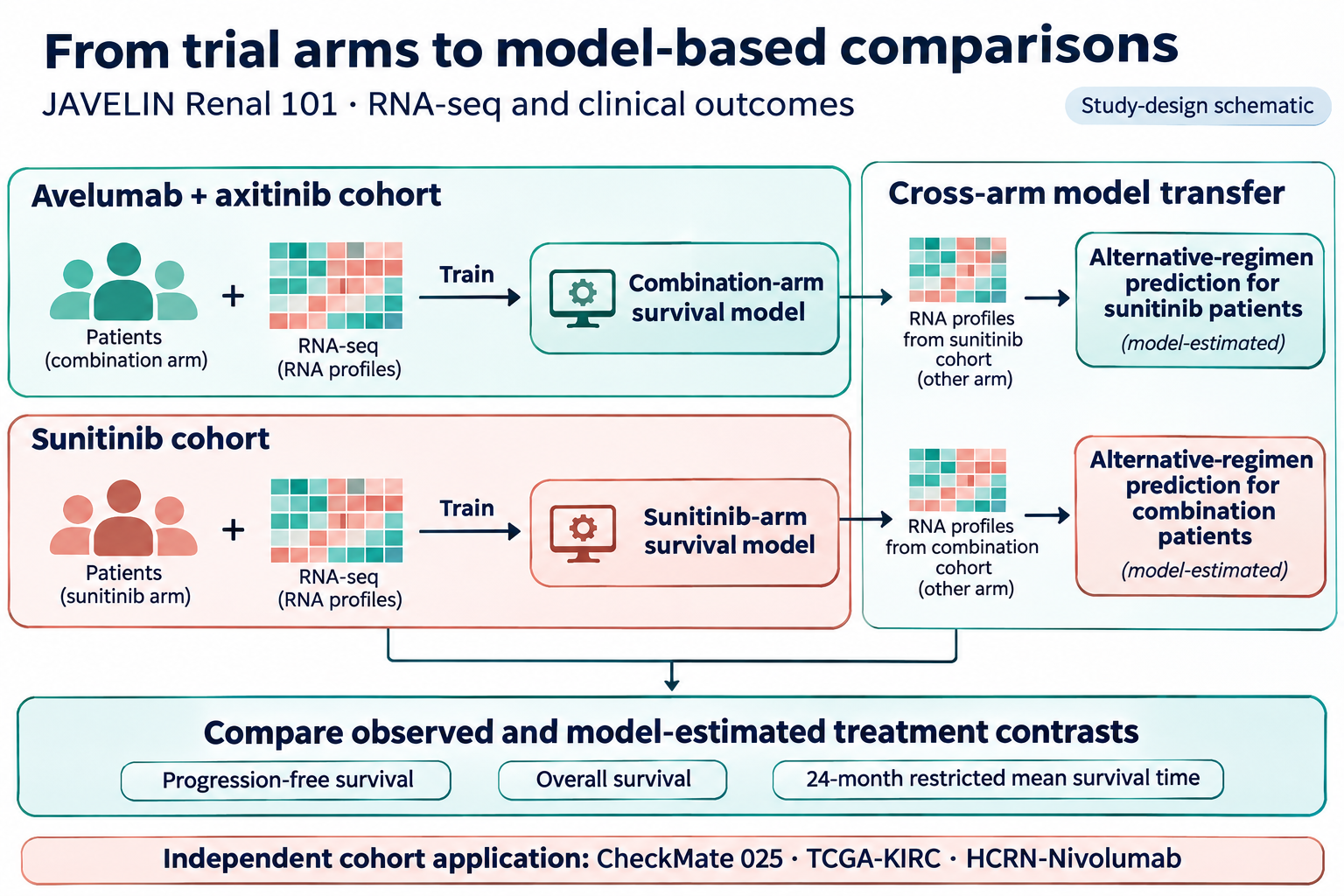
Keeping the training cohort, the application cohort, and the source of each outcome explicit is central to interpreting this design. The observed comparison comes from trial data; the alternative outcomes are estimated by the transferred models.
Observed and estimated PFS
In the available trial data, both the observed and the model-estimated comparisons favored the combination for progression-free survival. Neither comparison identified a statistically significant overall-survival benefit.
| Comparison | Median PFS: combination | Median PFS: sunitinib | 24-month RMST difference |
|---|---|---|---|
| Observed | 13.6 months | 8.1 months | +2.68 months |
| Model-estimated | 12.4 months | 8.3 months | +2.29 months |
Restricted mean survival time (RMST) summarizes time without progression over a defined horizon. The table compares reported summaries; it is not a reconstruction of the underlying survival curves.
Application beyond the trial
The framework was also applied to CheckMate 025, TCGA-KIRC, and HCRN-Nivolumab cohorts. These applications examine how the model-derived pattern behaves outside the development trial. Agreement with a known trial contrast is a useful check, while causal interpretation in another cohort depends on its patient population, measurements, and treatment-assignment assumptions.
A productive use of the framework is to prioritize hypotheses for further testing: identify where a treatment contrast is reproduced, where it fails to transfer, and which patient or data differences might explain that failure.